
How content owners and distributors can get content into connected vehicles – subscription, pay-per-view, and ad-funded media
by: Lawrence Harte, EV Business
The Rise of the Vehicle as a Streaming Platform
Connected vehicles are rapidly becoming one of the most important new distribution channels for streaming media, effectively transforming cars into mobile digital entertainment platforms. With embedded connectivity, high-resolution displays, and advanced infotainment operating systems, vehicles are now capable of delivering OTT-quality video, audio, and interactive services directly to drivers and passengers.
For content owners and distributors, this shift represents a major opportunity: vehicles are evolving into the next major screen, alongside mobile, TV, and desktop. Unlike traditional media environments, vehicles offer highly engaged, captive audiences, contextual data (location, time, behavior), and new monetization opportunities.
Connected vehicles are a major new OTT distribution channel, with approximately 876 million connected vehicles today—about 45% of which support video—growing to over 1.3 billion by 2030, when more than 80% are expected to be video-capable and each connected vehicle will have about 2.9 video screens.
The key question is no longer if content should be distributed to vehicles—but how to effectively deliver, monetize, and scale streaming media within automotive ecosystems.
Types of Video Content for Vehicles
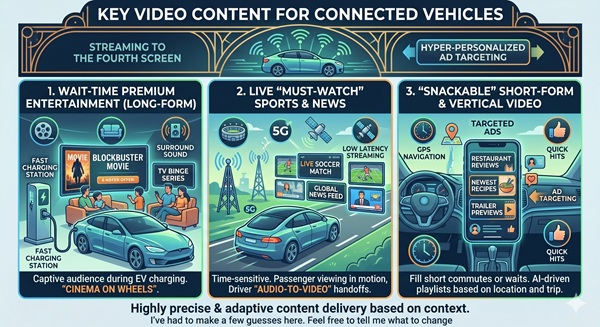
As the vehicle transitions from a simple mode of transport to a “living room on wheels,” video content owners and OTT providers are prioritizing three distinct categories of video content designed to fit the unique constraints and opportunities of the automotive environment.
Long-Form Content: Capturing the Charging Experience
Long-form content, including movies and episodic television, is particularly well suited for stationary viewing scenarios. The rapid growth of electric vehicles has introduced a new behavioral pattern: drivers and passengers spending 20 to 60 minutes parked at charging stations. This “charging window” is becoming one of the most valuable opportunities for OTT engagement within the vehicle. During these sessions, users are highly receptive to immersive, high-quality entertainment experiences. Automakers are increasingly enabling cinema-like environments inside the vehicle, integrating high-definition displays with premium audio systems to deliver a compelling “theater on wheels” experience. OTT platforms that can seamlessly integrate their apps into these environments stand to capture significant viewing time that would otherwise occur in the home.
Live Sports and News: Driving Daily Engagement
Live sports and news content represent a second critical category, driven by their time-sensitive and habit-forming nature. Unlike on-demand content, live programming encourages frequent check-ins and supports daily active usage. In the vehicle environment, this content is particularly valuable because it can adapt to both stationary and in-motion scenarios. Passengers can watch live events on dedicated screens while the vehicle is moving, while drivers can engage through audio streams that transition to video when conditions permit, such as when the vehicle is parked or stopped. Advances in 5G connectivity and hybrid satellite delivery are enabling low-latency streaming even at highway speeds, reducing buffering and ensuring a consistent viewing experience. For OTT providers, this creates an opportunity to extend live content engagement into moments that were previously inaccessible.
Short-Form Video: Winning the Micro-Moments
The third category—short-form and vertical video—is designed to address the fragmented and time-constrained nature of many vehicle journeys. Short commutes, school pick-ups, and quick errands create brief windows of opportunity for content consumption, favoring formats that are easy to start, consume, and complete within minutes. This is where snackable content, including highlights, news clips, weather updates, and social video, becomes highly effective. Increasingly, OTT platforms are leveraging artificial intelligence to curate personalized playlists based on trip duration and destination data, ensuring that content aligns with the user’s available time. This level of contextual adaptation not only improves the user experience but also increases completion rates and engagement metrics.
Monetization: Location-Aware and Interactive Advertising
From a monetization perspective, short-form content also opens the door to highly targeted advertising models that are uniquely enabled by the vehicle environment. Location-aware advertising allows content providers to deliver contextually relevant messages, such as promoting nearby restaurants, retail locations, or services along a route. Because the vehicle provides real-time data about location and movement, advertisers can achieve a level of precision and timeliness that is difficult to match on other platforms. Combined with interactive capabilities—such as touchscreens and voice interfaces—this creates opportunities for direct response and commerce within the vehicle, further enhancing revenue potential.
Building a Unified In-Vehicle Content Strategy
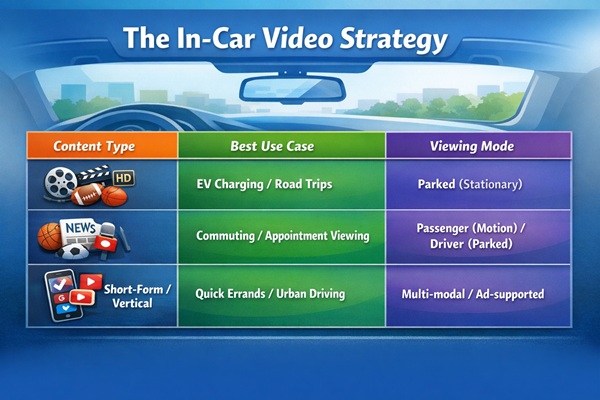
Taken together, these three content categories form the foundation of an effective in-vehicle streaming strategy. Long-form content captures high-value, extended viewing sessions during stationary periods. Live content drives habitual engagement and real-time relevance. Short-form content fills the gaps between longer sessions and enables scalable, ad-supported monetization. For content owners and OTT distributors, the ability to orchestrate these formats within a unified platform will be critical to maximizing both audience reach and revenue.
Navigating the Automotive Platform Ecosystem
As vehicles continue to evolve into software-defined platforms with robust connectivity and app ecosystems, the competitive landscape for OTT distribution will expand accordingly. Automakers are increasingly acting as platform providers, creating new interfaces and marketplaces for content delivery. At the same time, technology companies are introducing operating systems and middleware that enable faster integration and deployment of streaming services. For OTT providers, this means navigating a complex but highly promising ecosystem that combines elements of consumer electronics, telecommunications, and automotive design.
Conclusion: The Vehicle as the Next Major OTT Destination
The rise of the connected vehicle as a streaming platform marks the beginning of a new era in digital media distribution. It introduces a new screen, a new context, and a new set of user behaviors that demand tailored content strategies and innovative monetization models. For content owners—whether focused on movies, live sports, or short-form video—the opportunity is substantial. Those who move early to adapt their content, optimize their delivery, and integrate with automotive platforms will be well positioned to capture audience attention in this rapidly growing channel.
In the evolving landscape of OTT, the vehicle is no longer just a mode of transportation—it is becoming a primary destination for content consumption.

About Lawrence Harte
Lawrence Harte is the editor of OTT Business, EV Business, and other emerging tech media publications where he interviewed over 4,137 executives and technologists since 2005. He is the podcast host for OTT Business Podcast and EV Business Podcast. He has written over 153 technology and business books primarily on Streaming Media (OTT), EV and Wireless. Lawrence has worked at leading companies Ericsson GE, Audiovox/Toshiba, Frontier and others. He has been an expert consultant for Google, Samsung, Nokia and many others.